Frozen In Time

We call it The Great Missouri Road Trip, and it happened last fall. My mom, my sister and I spent almost a week visiting old family places in Missouri: my mom’s girlhood homes, old cemeteries, the tiny bank building where my grandparents met. We also toured the gorgeous State Capitol in Jefferson City and generally had a wonderful time. Heading home through Arkansas, we stopped around 3:00 p.m. for a fuel/restroom break. When we saw the Baskin-Robbins Ice Cream counter inside, we looked at each other. It was unanimous — ice cream for three, please. The ice cream lady asked each of us whether we wanted a cup or a cone. Mom hesitated a minute and then asked for a cone.

As we stood around eating and bragging about how good the ice cream was, Mom shook her head with a self-deprecating laugh. “Look at me,” she said, “eating an ice cream cone like a little kid!” It struck me that in her mind, cones were for Children, while Grown-ups ate their ice cream from a Bowl. Getting a sugar cone for her ice cream was a genuine adventure for her; a little mild recklessness or rebellion. I later mentioned this to my sis and told her that Mom seemed to carry a lot of rules in her head.

Days after the trip ended, I thought about it again and realized that many of Mom’s “rules” have nothing to do with integrity or morality. Rather, they are mere conventions that arose somewhere in generations past. There is no logical reason for the cone/cup age-appropriateness idea, but that was probably the convention she grew up with. Like not wearing white after Labor Day, or how women used to never go out without a hat or gloves or whatever.

I remember Mom telling me about how her own mother would never wear sleeves above the elbow, even in their un-air-conditioned house in summer, because she was “too old.” Mom recognizes how unnecessary that convention was, but she is still bound by others equally needless. For instance, when she and Dad started attending a new church in my hometown, a friend invited Mom to sit with her during the service. This lady always sat on the left side of the auditorium. Mom kept sitting by her week after week, although she really wanted to sit toward the right, where she could watch the organist play and see the keyboard. One day she told me how frustrated and disappointed she felt about the situation. I suggested she just tell her friend that she wanted to watch the organist, and invite her to sit with her along the right-hand side. Mom shook her head. “I can’t,” she said. “That’s just not done.” Mom cheated herself out of enjoying part of the church service because she felt trapped by some impersonal expectation that the friend herself probably had no idea of. 

The habit of blindly following conventions would not trap people if there were not a certain attraction in doing so. One thing about conventions: they keep you from having to make decisions. An indecisive person can just fall back on the “rules” and blend in with everyone else. For someone who grew up with adults making all the decisions, it is an easy way to maintain that hands-off approach to your own life.

Of course, I would not advocate just doing exactly as you please all the time, with no regard for anyone else. And of course, conventions are not always bad. Many of them are just mutual agreements to help us know how to act around each other, so everyone knows what to expect. They can lubricate society and help us make each other comfortable. Here in the US, we shake hands when we meet someone. Everyone drives on the right (left would work just as well if we all did it). When you sit down to a meal, you expect to find the food on dishes, with flatware for eating it.

Next time you feel that you “must” or “mustn’t” do something a certain way, try asking yourself why. Is there a valid principle behind that feeling, or just an outdated or needless convention? Here are a few for practice . . .

1. My shoes must match my purse. (convention)
2. I must not steal the neighbor’s lawn mower. (principle)
3. If I wear a skirt and dress shoes, I must wear pantyhose with them. (convention)
4. I must not wear pantyhose, even with a skirt and dress shoes. (more recent convention)
5. I must not spread hurtful rumors. (principle)
6. On Thursday, I must do all the ironing. (really old convention — even before my time!)

I want to be aware of why I do what I do, and keep convention in its proper place. Where convention and God’s clear instructions conflict, I want to follow God. I don’t want to get frozen into letting old habits — or my culture –think for me.

Well, gotta go. It’s Monday, so I must do all the laundry. —JUST KIDDING!

Thanks for reading!
Jan

Posted in Everybody Has a Story, Near As I Can Figure..., Uncategorized | 1 Comment

… People Too

by Janice C. Johnson
This nonfiction piece earned a place in the 2007 literary journal of UTA’s “Sigma Tau Delta” (English honor society) chapter.

One is a sweet, gentle blonde, the other a spunky and affectionate redhead. My husband Brent and I named them both. We provide for their physical and emotional needs, and are trying to teach them to be responsible members of society. We appreciate and encourage their differing talents and interests. I often address them collectively as “girls.” My beloved daughters? Well… no… my kids are both boys. I’m talking about my yellow Lab mutt Aggie, and our son’s Pomeranian mutt Tipper. I know they’re dogs, all right; I’ve never been one to cook for them or put clothes on them or anything like that. It’s just that with their companionable personalities, it’s easy to forget they are not human. They seem downright ladylike in repose, Aggie crossing her dainty front paws and looking regal, while Tipper lounges in front of the fireplace with her long hair draped over the tiles. But every once in a while something happens to remind me — forcibly — that they are dogs after all, complete with doggie instincts.

In retrospect, it was not my fault in the least and I shouldn’t feel guilty. Mr. and Mrs. Mockingbird had to notice the two dogs in the back yard when they decided to build a nest just three feet from the ground. I didn’t even know about the nest until one warm spring day when one of the Texas Sage bushes started making little squeaky noises. I peeked in to investigate. Four scrawny grey necks topped by bright yellow funnels stretched up, awaiting their next serving of bugs. Not wanting to delay their lunch, I went away.

Over the next few weeks, I saw the little guys grow from dollops of grey fuzz into something that more resembled birds, with those ugly baby-bird faces that only emus never seem to outgrow. Then one Friday the nest was empty. Well, congratulations, Mrs. Mockingbird; I guess they are launched.

When I let the dogs in for the night, Aggie picked up a toy and brought it in with her as usual. But the toy seemed unfamiliar so I took a closer look. Aggie beamed at me as two limp, scaly, claw-tipped legs dangled from one side of her mouth. Horrified, I hustled her back out. It was far too late to help the defunct bird and neither Brent nor I felt like wrestling it away from her (negotiations were short and consisted mostly of “eew!”). We ended up just leaving her outside to finish her business with it.

Saturday morning dawned with no visible trace of Aggie’s late-night snack. Relieved, I fed the dogs (a little less than usual for Aggie) and went on about my day. Later I let them in from the midafternoon heat. To my dismay, Aggie proudly carried in a dead juvenile mockingbird. AGAIN. Was it the same one, buried and then exhumed, or a sibling? I don’t know, but this bird looked decidedly shopworn. Out went Aggie with her ill-gotten prize, while I pondered whether the Feds would come after me for letting my dog eat the state bird. Or would it be the Texas Rangers? Not the baseball team; the law enforcement people.

I never actually saw Tipper sharing the spoils, but it may have been more than coincidence that an unpleasant aroma issued from her crate the next morning. Sure enough, she had had diarrhea — her only crate accident in over three years. It was all over the old mattress pad she slept on. Could this weekend get any more gross? I tugged the bedding out and set it in the garage to dry. Fortunately, dogs are impervious to sarcasm, so Tipper just wagged her tail when I asked whether she had eaten too many fries with her mockingburger.

After church and a nice, fortifying lunch, I went outside to clean up Tipper’s mattress pad. My plan seemed simple enough: shake out the dry dog poop onto the grass and then hose off as much of the residue as possible. However, two key facts escaped my notice:

1. The elastic edging created a curve which threw off the trajectory.

2. It wasn’t dry.

I felt the first splat near my collarbone, followed the next instant by a smaller blob landing somewhere below my right eye. Miraculously, Brent came outside at that moment with a rag in his hand, bent on some bicycle maintenance task. He noticed my mottled appearance but it was too late to make good his escape.

Still clutching the offending mattress pad, I said, “Honey, would you wipe this off me? I can’t see where it is!”

Brent courageously came within arm’s length and sacrificed his rag to make me more presentable. As I stood in the driveway radiating gratitude and a pungent odor, I found myself feeling strangely calm. In fact, an odd nostalgia enveloped me. It occurred to me that this didn’t say much for my mental balance.

By the time I had taken a hot (antibacterial) shower, though, I realized where the nostalgia came from. Smells are supposed to be our most powerful memory triggers. That particular smell had recalled me to those early years of motherhood, when “nurturing” sometimes meant cleaning up unspeakable messes at 3:00 a.m., and the word “projectile” was an ordinary part of my vocabulary. All I normally remember from those times is the tenderness I felt toward my babies. I wouldn’t trade even the smelliest moments for anything. And I’m delighted that nobody ate my children as soon as they were able to step out of the nest.

Thanks for reading!
Jan

Posted in I Remember When... (my OWN stories), Uncategorized | 9 Comments

“Competitive”

In my ongoing quest to be right (to have the right answers, the right actions and the right attitude), I ran across yet another foible in my character. To me, the idea of being “competitive” smacks of pride or even arrogance, so I would like to avoid it. When my boys were babies, for example, I steered clear of comparing their development with that of other people’s babies. How old was he when he doubled his birth weight, someone would ask. –No idea. How tall was he at one year? –You got me. When did he say his first word? –Dunno. I would celebrate those milestones as they came, but was not motivated (or was just too lazy) to keep track of them for comparison between my own two, or with other people’s kids.

Imagine my surprise, then, when I was chatting on the phone with a girlfriend / fellow mom, and she made the offhand comment that she thought I was competitive. To her, the word “competitive” was a neutral adjective, like “tall” or “red-haired.” But I felt insulted. The first thought that raced through my head was, Oh, yeah? I bet I’m less competitive than you are!

Was I actually competing to be the least competitive?? That’s when the light bulb came on and I knew I had it bad. The harder I tried to avoid a prideful attitude, the prouder I was of it. Oops, time for an apt and well-timed quote to deflect attention from my glaring inconsistencies:

“The heart is deceitful above all things and beyond cure.
Who can understand it?” (Jeremiah 17:9, NIV)

See, it isn’t just me. Apparently it’s a “human” thing. In his novel The Screwtape Letters, C.S. Lewis gives us an imaginative behind-the-scenes look at spiritual warfare from the demonic point of view. The veteran tempter Screwtape offers advice to his inexperienced nephew, who is trying to lure his human “patient” away from following God. Here he deals with this exact same issue…

All virtues are less formidable to us once the man is aware that he has them, but this is specially true of humility. Catch him at the moment when he is really poor in spirit and smuggle into his mind the gratifying reflection, “By jove! I’m being humble”, and almost immediately pride—pride at his own humility—will appear. If he awakes to the danger and tries to smother this new form of pride, make him proud of his attempt—and so on, through as many stages as you please. But don’t try this too long, for fear you awake his sense of humour and proportion, in which case he will merely laugh at you and go to bed. (Chapter 14)

Lewis is one of my favorite authors, and once again he has made me both smile and think. The text recalls the question that Jeremiah asks above, and Chapter 4 of the novel echoes the answer which Jeremiah gives in the very next sentence:

“I the LORD search the heart and examine the mind…” (v. 10)

There is no point in trying to deceive myself as to my motives; God knows me inside out and He knows exactly what to do about it. Instead of my getting all wrapped around the axle trying to manufacture right and good motives (here we go again), how freeing it would be to laugh at the dilemma and simply rest in His grace. As I spend time getting His words into my life, He will change my motives to more closely resemble His.

As near as I can figure, life works best when I just trust and follow, and let God do the searching and changing. (I bet I thought of that before you did. JUST KIDDING!)

Thanks for reading!
Jan

Posted in Near As I Can Figure..., Uncategorized | 1 Comment

Right Answers

Middle-born children are supposed to be people-pleasers, and I have reason to believe it. As far back as I can remember, I tried to give people the right answer to any questions they might ask me, including questions about myself — the right answer being whatever I thought was expected of me. I tried to convince others (and myself) that the right answer was the truth.

Exhibit "A"

Exhibit "A"

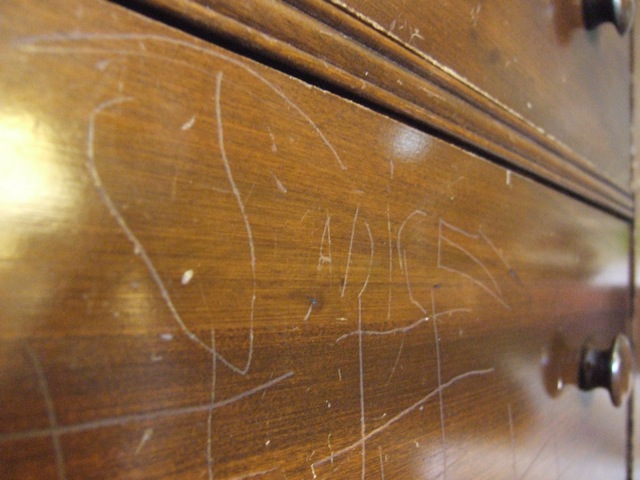
When I was little, Mom printed my name for me in all capitals, and I would copy it letter by letter. One day I was sitting on my floor in front of a dresser. I had a ballpoint pen in my hand, and inspiration hit: maybe I could write my name without looking at the model. Absolutely oblivious to the damage I was doing, I scratched “JANICE” into the front of a drawer.

When Mom saw the writing, she naturally asked me how it got there. This question triggered my right answer mechanism. I realized that I should not have written on that drawer, but was not smart enough to tell the truth. I tried to blame it on my older brother who, even if he had wanted to carve my name into the furniture, which he didn’t, would have done a much neater job of it.

Another memory is of a discussion in my second-grade Sunday School class: the teacher asked us multiple-choice questions about what we would do in various situations. One question involved seeing some trash left in a neighbor’s front yard. Obviously, “I would pick up the trash” was the right answer, so that’s the one I gave. In reality I would have been too shy to go into a neighbor’s yard even if I had dropped something there myself, let alone barge in and pick up strange trash. But I wouldn’t admit it in a million years.

I’m not a compulsive liar; normally I am meticulously honest, not taking so much as a paper clip that isn’t mine. So why on earth did I lie? As near as I can figure, I would have to call it insecurity. I wanted to be right and good, and the only way I could see to achieve that was to look right, to look good. If there was a right answer, I had to already know it — or I at least wanted you to think I already knew it. Again, it’s not that I intended to deceive; it was more that I hoped saying the right answer would somehow make it true. (Well, except for that first one when I tried to blame my brother. That was just a flat-out lie. Still, wishful thinking was involved.)

Somewhere along the way, though, something happened that helped break the cycle. One of the right answers I had been giving was, “Yes, I have received Jesus as my Savior.” I wanted to be a Christian, as people thought I was, but I had never taken the necessary step of faith. My self-remedy for the emptiness and fear that haunted me was to fake faith and assurance. It didn’t work. Finally, I accepted Jesus’ offer to forgive my sin and give me eternal life. When I did, He took all my “wrongness” away and credited His rightness to my account instead. That was when the right answer also became the true answer. I feel much more comfortable in my own skin since then. I have no more confidence in myself than before, but I have confidence in Him. Now I can learn from others, and even ask questions — in public! I seldom worry about appearing imperfect. When necessary I can look someone in the eye and say, “I just made the dumbest, most colossal mistake…”

But that old, insecure nature still crops up at times.

When my sons were young I called the Crayola company with a question. After answering it, the customer service lady wanted to ask me a survey question, and I agreed. It went something like, “Many people are under the impression that our crayon color ‘Indian Red’ refers to the skin color of Native Americans. The name actually refers to a dye used in India. Did you think it referred to Native Americans?” My whole childhood passed before my eyes. I had ALWAYS assumed that “Indian Red” was intended for coloring Native Americans (which we still called “Indians” back then). I used “Indian Red” every November for my First-Thanksgiving Indians, all the way through elementary school, even though I privately doubted that anyone’s skin had that intensely brownish-red color in real life. Did I admit as much to this total stranger, whom I would never meet and who didn’t know or care who I was? Of course not. What I did manage to say (in my shock at learning the true meaning of “Indian Red”) was something like, “Oh — why, no, I (ahem) didn’t think that…”

Call it a flashback. But at least I can admit it.

Thanks for reading!
Jan

Posted in Near As I Can Figure..., Uncategorized | 4 Comments

It Takes a Village

As a writer, one of my priorities is to encourage my readers — to put a positive spin on their day by adding a touch of humor, faith, helpful information, or any combination thereof. I do love to relate to people. Only… I seem to spend an awful lot of time at home, in front of my laptop. All by myself. You don’t have to be an eccentric recluse to write, but it would be mighty easy to become just that.

The danger in being a reclusive writer is that I would lose touch with the very resource that will sharpen my faith and humor, and bring about much of the helpful information I would like to share: namely, other people. If I just keep my rear in my desk chair all the time, my store of things to write about will soon run dry.

Fortunately, my magazine assignments get me out of the house and into other people’s lives. I have met some fascinating characters, and always learn something or gain some inspiration from each one. You can catch a few of these conversations in the sidebar.

But I have discovered another source of mutual inspiration and support: online friends, some of them fellow bloggers. On Fridays, I like to link up with as many “Company Girls” friends as possible. They may offer a frank look at some situation where they don’t know what to do, or perhaps where they have failed. I can usually relate, and their transparency blesses and encourages me. Equally inspiring are the victories or fresh insights they share. I’ve been challenged to pray with more faith; to be kinder to my home, my family and myself; to appreciate some blessings that God has showered on me, but which I had not even noticed. It is mutual, too: sometimes I hear that my words have blessed someone else. I have really hit it off with some of these ladies, who have become real friends. All good stuff!

But now, to complete the picture (and avoid becoming an eccentric recluse), I need to get out there and use what I have learned. And in the process, I can gain some insights of my own, and pass along some of God’s blessings to other people, which is the whole point of getting those blessings in the first place.

As near as I can figure, it’s a matter of balance. Indoor/outdoor; give/take; solitary/social; output/input; virtual/real-life. We all need each other; everybody has something to offer. And everybody has a story, as I may have mentioned before. I hope you will link up with some of the blogs in my sidebar or at today’s “Company Girl Coffee.”

Thanks for reading!
Jan

Posted in Near As I Can Figure..., Uncategorized | 14 Comments

Redneck Traffic Jams

Or, Murphy’s Laws of Cycling In The Boonies.

Law #1 is that if you, the cyclist, are going to meet an oncoming motor vehicle on a narrow road, there is a 75% chance that it will be in a corner. (Of these, 67% will be blind corners.) For some reason, if the motor vehicle is the one turning left, it will almost inevitably be cutting across the corner — yeah, into your lane.

This happened to Brent last week. An oncoming pickup truck nearly forced him into the ditch on the right-hand side of the road, and the driver’s side mirror came within an inch or two of hitting his head. The driver did not seem to hear the helpful driving advice Brent offered, despite its being delivered at full volume. Of course, the guy was on his cell phone so that may explain it.

Law #2 covers the 25% of motor vehicles that you will meet along straighter, non-corner stretches of road. This law dictates that at the moment you meet the vehicle, there will be an obstacle in your lane that you need to go around. For me, it’s usually roadkill or a pothole. One recent morning the oncoming vehicle was a heavy utility truck that took up almost the whole road. The obstacle was the last 18 inches of a snake that was slithering, at an ever-so-leisurely pace, off into the grass. Fortunately I saw the snake in time to slow down for it without going over the handlebars. “Move it, Slinky,” I muttered. I was not about to run over a snake. Not me.

But even Murphy could not have come up with laws to explain some of the “traffic jams” I have experienced.

Sometimes it is a work crew, blocking the road for so long that there are actually a couple of cars waiting to pass — from each direction. This sort of phenomenon would make the local newspaper, if someone phoned it in. Last time I came across this situation, which involved a tree-trimming crew, a Lexus, two pickups and an SUV, I just made a U-turn and recalculated my route.

More often I unwittingly cause the traffic jam myself, when people in a car pull up to ask me for directions, as if a middle-aged woman in neon yellow Lycra knows how to get to any place they would want to go. Reluctant to knock me over (and thus prejudice me against giving helpful directions), they just stop right in the road rather than pulling onto the shoulder. Sometimes another car will come from behind and need to go waaaaay around us and that, of course, is when a third car will approach from the opposite direction. Delicate negotiations ensue.

Sometimes it’s just bizarre. One morning toward the end of summer I was riding along, intending to turn south from one little backroad onto another. As I approached the corner another local cyclist, affectionately known as “No-Helmet Guy” for reasons I will leave you to figure out, came from the other direction and turned south just a few moments before me. He was sitting up and not riding fast at all. As I caught up and was about to pass him, I realized that he was talking on his cell phone. I wasn’t sure whether he had noticed me, and I hate to startle another rider, especially one who is riding one-handed with no helmet while engrossed in a phone conversation, but he really was just poking along. I’d better go ahead and pass, I thought, checking my little helmet mirror which looks sort of dorky but which has saved my hide too many times to count. A single headlight was approaching from the rear so I decided to wait until the motorcycle had passed. Make that two motorcycles. No, four — seven — dang, it’s like a county-wide club or something. The road was so narrow that I didn’t feel safe passing until they had all gone around us. I lost count, but I know that at least twenty Harleys rolled by. One by one. In… no… particular… hurry.

As I finally accelerated into the faint haze of Harley exhaust and looked in my mirror, I got one last glimpse of No-Helmet Guy, still sitting up and talking on his phone as if nothing unusual had happened. So much for worrying about startling him.

Maybe I’ll change his nickname to Murphy.

Thanks for reading!
–Tailwinds,
Jan

Posted in Thoughts on Two Wheels, Uncategorized | 2 Comments